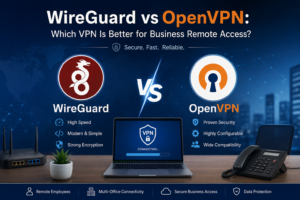
Remote access is no longer a luxury for modern businesses. Whether your team works from home, on the road, or across multiple office locations, a secure VPN is essential for protecting company data and keeping users connected to internal resources. Two of the most popular VPN technologies for business remote access are WireGuard and OpenVPN.
Both are widely used, both are secure, and both can be excellent choices depending on your environment. But if you are trying to decide which one is better for your business, the answer depends on your priorities: speed, simplicity, compatibility, or advanced configuration.
In this article, we will compare WireGuard vs OpenVPN in a practical, business-focused way so you can choose the right solution for your remote access needs.
What Is WireGuard?
WireGuard is a modern VPN protocol designed to be fast, lightweight, and easy to deploy. It was created with simplicity in mind and uses fewer lines of code than many traditional VPN solutions. That smaller codebase makes it easier to audit and often easier to maintain.
For businesses, WireGuard is attractive because it delivers:
- High performance
- Low latency
- Simple configuration
- Strong encryption
- Good support on many routers, servers, and client devices
WireGuard is especially useful for remote employees who need fast and stable access to office systems, file servers, or internal applications.
What Is OpenVPN?
OpenVPN is one of the most established VPN technologies in the world. It has been around for years and is trusted by many businesses because of its flexibility, maturity, and broad compatibility.
OpenVPN can run over both UDP and TCP, which makes it useful in environments where network restrictions are strict. It also supports a wide range of authentication methods and advanced enterprise settings.
For businesses, OpenVPN is known for:
- Strong security
- Excellent compatibility
- Flexible deployment options
- Mature enterprise features
- Ability to work in restrictive networks
If your business values proven reliability and broad support across older devices and mixed environments, OpenVPN remains a very strong option.
WireGuard vs OpenVPN: Key Differences
1. Speed and Performance
WireGuard is generally faster than OpenVPN. It was built to be efficient, and in many real-world business remote access setups, it provides better throughput and lower latency.
This matters when employees need to:
- Access remote desktops
- Transfer large files
- Use cloud apps through the VPN
- Work on bandwidth-sensitive tasks like VoIP or video calls
OpenVPN is still capable and secure, but it typically has more overhead and may not match WireGuard’s performance in the same hardware environment.
Winner for speed: WireGuard
2. Ease of Setup
WireGuard is simpler to configure. Its configuration is usually cleaner, with fewer moving parts and less complexity. That makes it a strong choice for small businesses or teams that want a streamlined VPN setup.
OpenVPN can take more effort to configure properly, especially if you need certificates, routing rules, custom authentication, and advanced policies. That extra complexity is not necessarily a weakness, but it does mean deployment and management can take longer.
Winner for simplicity: WireGuard
3. Security
Both WireGuard and OpenVPN are secure when configured correctly. WireGuard uses modern cryptography and a smaller codebase, which many administrators appreciate from a security and maintenance perspective.
OpenVPN has a long track record and has been trusted in enterprise environments for many years. Because it has existed longer, it has also been tested in many different scenarios.
From a security standpoint, both are strong choices. The real difference is often not the protocol itself, but how well it is configured and maintained.
Winner for security: Tie
4. Compatibility
OpenVPN has the edge when it comes to compatibility. It works across a wide range of devices, operating systems, and network environments. It is often easier to deploy in businesses with older systems or mixed hardware.
WireGuard support has grown quickly and is now available on many platforms, but OpenVPN still has the advantage in legacy and enterprise compatibility.
Winner for compatibility: OpenVPN
5. Battery and Resource Usage
WireGuard is generally lighter on system resources. It uses less CPU and is more efficient on both client devices and servers. This can be especially important for laptops, mobile devices, and small routers.
OpenVPN can be more resource-intensive, particularly on lower-powered devices or routers with limited processing capacity.
Winner for efficiency: WireGuard
6. Advanced Features and Control
OpenVPN offers more mature enterprise features and configuration options. This can be helpful for businesses that need complex policies, custom routing, certificate-based access control, or strict compliance requirements.
WireGuard is intentionally minimal. That is one of its strengths, but it also means it does not offer as many built-in advanced controls as OpenVPN.
Winner for advanced enterprise flexibility: OpenVPN
Which VPN Is Better for Business Remote Access?
The best choice depends on your business needs.
Choose WireGuard if you want:
- Faster performance
- Lower latency
- Simple configuration
- Better efficiency on routers and client devices
- A modern VPN solution for remote workers
Choose OpenVPN if you want:
- Maximum compatibility
- Mature enterprise features
- Support for older devices and restrictive networks
- More advanced configuration options
- A solution that is already familiar to your IT team
In many modern business environments, WireGuard is the better choice for remote access because it is fast, lightweight, and easy to manage. It works very well for employees connecting to office resources, especially when performance matters.
However, OpenVPN is still the better option in some situations, especially when your business needs broader compatibility or more complex enterprise controls.
Best Practice for Business VPN Deployment
No matter which VPN protocol you choose, the success of your remote access setup depends on proper design and implementation. A secure VPN should include:
- Strong authentication
- Proper firewall rules
- Network segmentation
- Access control by user or device
- DNS and routing protection
- Regular testing and monitoring
- Backup and recovery planning
A VPN is not just about connecting users. It is about building a secure, reliable remote access path that protects your business while keeping work simple for your team.
WireGuard vs OpenVPN: Final Verdict
If your business wants a modern, fast, and easy-to-manage VPN, WireGuard is usually the better choice.
If your business needs maximum compatibility and advanced legacy-friendly options, OpenVPN may be the better fit.
For many companies, the decision comes down to this:
- WireGuard for speed, simplicity, and efficiency
- OpenVPN for compatibility, flexibility, and mature enterprise support
The right VPN is the one that matches your network design, user needs, and security requirements.
Need Help Setting Up Business VPN Remote Access?
At Ahmad Networks, I help businesses set up secure remote access VPN solutions for employees, offices, and distributed teams. Whether you need WireGuard, OpenVPN, site-to-site VPN, or router-based remote access, I can help you design a stable and secure setup that fits your environment.
If you need professional VPN configuration, remote access design, or network troubleshooting, visit ahmadnetworks.com to learn more.
FAQ
Is WireGuard faster than OpenVPN?
Yes, in most cases WireGuard is faster because it is lighter and more efficient.
Is OpenVPN still good for business use?
Yes. OpenVPN is still widely used and remains a strong choice for business environments that need compatibility and advanced configuration.
Which VPN is easier to manage?
WireGuard is generally easier to set up and manage.
Which VPN is more secure?
Both are secure when configured properly.
Can I use both WireGuard and OpenVPN in one business?
Yes. Some businesses use WireGuard for modern remote access and OpenVPN for legacy systems or special cases.